What Developer Volume Should You Use With Bremod Hair Color?
The correct Bremod hair color developer volume depends on your starting colour, chosen shade, hair condition and whether you want to deposit colour, cover greys or lighten your natural hair.
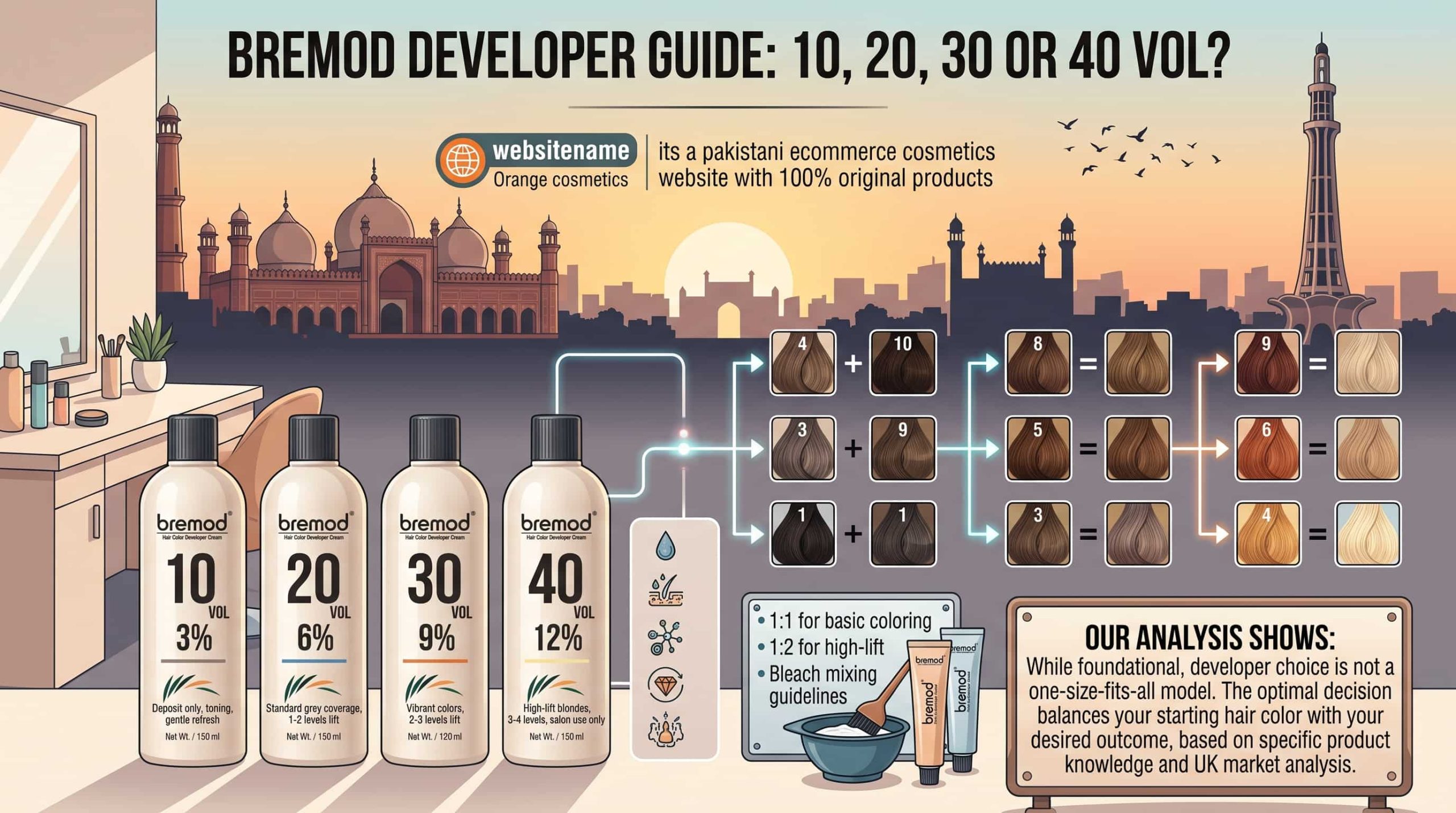
As a general guide, 10 volume is mainly used for depositing colour with minimal lift, while 20 volume is commonly selected for permanent colouring, grey coverage and limited lift. Thirty volume provides stronger lightening, whereas 40 volume is a high-strength option that should normally be handled by an experienced colourist.
These are general developer principles, not universal instructions for every Bremod formula. Always check the packaging supplied with your particular shade because the required developer strength, mixing ratio and processing time can vary.
Quick Answer
| Desired result | Common developer choice | General effect |
|---|---|---|
| Darken the hair | 10 volume | Primarily deposits colour |
| Refresh the tone at a similar level | 10 volume | Minimal lift |
| Standard permanent colour | 20 volume | Deposits colour with moderate opening of the cuticle |
| Cover grey hair | Often 20 volume | Supports permanent colour and grey coverage |
| Lighten natural hair by approximately 1–2 levels | 20 volume | Moderate lift |
| Lighten resistant natural hair further | 30 volume | Stronger lift |
| Use high-lift colour | Product-dependent | May require 30 or 40 volume |
| Major lightening | Professional assessment recommended | May require a separate lightening process |
Twenty volume is the most common starting point for ordinary permanent hair-colour applications, but it is not automatically correct for every person or shade.
If you are unsure, use the developer specified on the Bremod packaging or consult a professional colourist rather than choosing a stronger developer for faster results.
What Does Developer Do in Hair Colour?
Developer is an oxidising cream that activates permanent hair colour.
It helps open the hair cuticle so the colour process can take place. Its strength influences how much natural pigment may be lifted and how the selected artificial pigment develops.
Developer volume broadly corresponds with hydrogen peroxide concentration:
| Developer volume | Approximate peroxide concentration |
|---|---|
| 10 volume | 3% |
| 20 volume | 6% |
| 30 volume | 9% |
| 40 volume | 12% |
A higher number does not mean a better result.
Stronger developer can produce more lift, but it can also increase dryness, irritation, unevenness and damage—particularly on previously coloured, porous or weakened hair.
The correct goal is to use the strength required for the intended result, not the strongest developer available.
When Should You Use 10 Volume With Bremod Hair Color?
Ten volume developer is the lowest of the four commonly available strengths.
It is generally considered when the objective is to:
- Deposit permanent colour
- Move to a darker shade
- Refresh a similar colour level
- Add or adjust tone
- Minimise unnecessary lift
- Colour hair that is already light enough for the chosen result
For example, someone with natural or previously coloured medium-brown hair who wants to apply a darker brown may not require substantial lift. A lower-volume developer may be more appropriate if permitted by the specific colour instructions.
Ten volume is not normally selected when significant lightening is required.
It may also provide insufficient grey coverage with some permanent-colour systems. If grey coverage is the main objective, check the manufacturer’s directions because 20 volume is more commonly recommended.
When Should You Use 20 Volume?
Twenty volume is commonly used with permanent hair colour because it provides a balance between pigment development and controlled lift.
It may be appropriate when you want to:
- Apply permanent colour
- Cover grey or white hair
- Maintain a similar level with reliable colour development
- Lighten natural hair modestly
- Move approximately one or two levels lighter
- Apply many natural brown, red or blonde shades
Suppose your natural hair is dark blonde and you want to apply a medium blonde shade. Twenty volume may provide sufficient lift, depending on the hair’s resistance and the exact Bremod formula.
Similarly, 20 volume is often considered for grey coverage when combined with an appropriate natural-base shade.
It will not reliably transform very dark hair into a pale blonde. Trying to achieve a large colour change with one application can produce warm, uneven or damaged results.
When Should You Use 30 Volume?
Thirty volume developer provides more lifting strength than 20 volume.
A colourist may consider it when:
- The target shade is noticeably lighter than the natural base
- Approximately two or three levels of lift are required
- Natural hair is resistant to colour
- A brighter result is required from a compatible formula
- The selected product specifically instructs the user to apply 30 volume
Thirty volume should be used more cautiously because it places greater stress on the hair and scalp.
It is not a solution for every dark-to-light colour change. The final result will depend on:
- Natural starting level
- Existing artificial colour
- Hair porosity
- Previous chemical treatments
- Underlying warm pigments
- Chosen shade
- Application technique
- Processing time
Previously dyed hair creates an additional complication. Permanent colour generally does not provide predictable lightening of artificial pigment already inside the hair. Applying a lighter Bremod shade with stronger developer may expose warmth or create uneven roots and lengths rather than producing the shade shown on the chart.
Should You Use 40 Volume With Bremod Hair Color?
Forty volume is a high-strength developer and should not be treated as a standard home-colouring option.
It may be used with certain professional high-lift colours or lightening techniques when the product explicitly permits it. However, it carries a greater risk of:
- Scalp irritation
- Excessive dryness
- Hair breakage
- Uneven lift
- Increased porosity
- Unpredictable colour
- Overprocessing
Do not select 40 volume merely because your hair is dark or because you want the colour to work faster.
Very dark hair contains underlying warm pigments that become visible as the hair lightens. A stronger developer does not guarantee a clean blonde result and may leave the hair orange, yellow, patchy or weakened.
Major lightening and corrective colour are safer when assessed by an experienced professional.
Which Developer Is Best for Grey Coverage?
Twenty volume is commonly used for grey coverage with permanent colour, but the correct combination also depends on the shade.
Grey or white hair may be:
- Fine and receptive
- Coarse and resistant
- Concentrated around the hairline
- Distributed throughout the hair
- Mixed with naturally dark hair
- Previously coloured
For stronger coverage, colourists often select a natural-base shade at the required level or combine it with the desired tonal shade. However, the exact formula and ratio should follow the Bremod instructions.
Developer strength alone does not determine grey coverage. Shade selection, saturation, application and processing time also matter.
Someone wanting to cover greys with medium brown should not automatically use a lighter fashion shade with 30 or 40 volume. That may lift the remaining pigmented hair while failing to provide the intended coverage.
Can Bremod Hair Color Lighten Previously Dyed Hair?
Applying a lighter permanent colour over previously dyed hair usually does not produce the same result as applying it to natural hair.
A stronger developer may lighten the natural roots while leaving the coloured lengths darker. This can create:
- Lighter roots
- Darker mid-lengths
- Warm bands
- Uneven colour
- Excessive dryness on the ends
If the lengths contain artificial dark pigment, they may require colour removal or controlled lightening before a lighter result is possible.
This type of correction should ideally be planned by a colourist. Repeatedly applying permanent colour and strong developer can worsen unevenness and damage without removing the unwanted pigment properly.
Does the Bremod Shade Number Affect Developer Choice?
Yes. The chosen shade indicates the approximate colour depth and tone, while the developer helps determine how the hair moves from its current level towards that target.
Before selecting developer, compare:
- Your current natural colour level
- Any existing artificial colour
- The Bremod shade level
- The desired amount of lift or deposit
- Your hair’s current condition
For example:
- Moving from natural level 5 to another level 5 mainly involves depositing or adjusting tone.
- Moving from natural level 5 to level 7 requires lift.
- Moving from previously dyed level 5 to level 7 may require colour correction rather than stronger developer.
- Moving from level 7 to level 5 involves darkening and generally does not require strong lift.
If you are still selecting your shade, read our guide on how to choose a Bremod hair color shade based on your starting colour.
You can also use the Bremod hair color shade chart to understand how the shade numbers represent depth and tone.
Can You Mix Different Developer Volumes?
Professionals may sometimes combine developers to create an intermediate strength, but this is not recommended for inexperienced home users.
Mixing different strengths introduces additional room for measurement errors. It may also depart from the instructions provided for the colour.
Do not:
- Dilute developer with water
- Mix developer with household peroxide
- Add shampoo or conditioner unless explicitly instructed
- Estimate quantities by eye
- Combine unrelated chemical systems
- Assume developers from every brand perform identically
Use a compatible cosmetic developer and measure it according to the product directions.
What Mixing Ratio Should You Use?
The mixing ratio tells you how much colour and developer to combine.
Common ratios in professional colouring include:
- 1:1
- 1:1.5
- 1:2 for certain high-lift formulas
However, these are examples—not a confirmed universal ratio for every Bremod shade.
Check:
- The colour tube
- Outer carton
- Included leaflet
- Developer packaging
- Official product instructions
Do not assume that a ratio used with one brand, shade family or lightener also applies to another.
Accurate measurement matters. Too much or too little developer may change consistency, coverage, lift and colour development.
How to Choose the Correct Bremod Hair Color Developer Volume
Use this decision sequence.
1. Identify your current colour
Determine the starting level of your natural roots.
Then assess whether the mid-lengths and ends are:
- Natural
- Permanently coloured
- Bleached
- Highlighted
- Henna-treated
- Chemically straightened
- Porous or damaged
Roots and lengths may require different treatment.
2. Identify the target shade
Find the level and tone of your chosen Bremod colour.
Do not judge only from the model image. Printed and screen colours may differ from the actual result.
3. Calculate the required change
Ask whether you are:
- Going darker
- Staying at a similar level
- Covering greys
- Lightening slightly
- Attempting major lightening
- Correcting previous colour
This determines whether the process primarily needs deposit, lift or professional correction.
4. Check hair condition
Weak, stretchy, brittle or highly porous hair may not tolerate strong developer safely.
Do not apply developer to an irritated, broken or inflamed scalp.
5. Follow the specific instructions
The directions supplied with the colour should take priority over general online advice.
If the required instructions are missing or unclear, ask a trained colourist or the retailer before mixing the product.
Example Developer Choices
These examples are general illustrations rather than personal formulas.
Darkening medium-brown hair
Desired result: dark brown
Likely priority: deposit rather than lift
Possible developer: 10 volume, if supported by the colour instructions
Covering greys with natural brown
Desired result: reliable permanent coverage
Likely priority: colour development and coverage
Possible developer: commonly 20 volume with a suitable natural-base shade
Moving from natural dark blonde to medium blonde
Desired result: limited lightening
Likely priority: approximately one or two levels of lift
Possible developer: commonly 20 volume, depending on the formula
Moving from natural medium brown to dark blonde
Desired result: stronger lift
Likely priority: several levels of lightening
Possible developer: potentially 30 volume, but professional assessment is advisable
Moving from dyed black to blonde
Desired result: major correction
Likely priority: removal of artificial pigment and controlled lightening
Possible developer: not a simple developer-selection problem; professional colour correction is recommended
Safety Checks Before Colouring
Always complete the tests and precautions specified by the manufacturer.
Perform an allergy alert test
Hair-colour allergies can be serious, and a person can react even if they have used colour previously.
Follow the product’s allergy-test instructions within the stated timeframe before every application.
Do not proceed if the test causes a reaction.
Perform a strand test
A strand test can help assess:
- Colour result
- Processing behaviour
- Hair condition
- Lift
- Underlying warmth
- Compatibility with previous colour
Select a small, concealed section and follow the intended formula and timing.
Protect the scalp and skin
Wear gloves and avoid applying colour to:
- Broken skin
- An irritated scalp
- Areas with rashes
- Eyebrows
- Eyelashes
Rinse immediately if the product enters the eyes and follow the packaging’s safety instructions.
Do not exceed the stated processing time
Leaving colour on longer does not guarantee better results. It may increase irritation, dryness or damage.
Use a timer and follow the instructions provided with the product.
Use suitable tools
Use a non-metallic mixing bowl and appropriate applicator unless the instructions state otherwise. Measure the colour and developer rather than estimating.
Where Can You Buy Bremod Hair Color in Pakistan?
Orange Cosmetics offers a range of original Bremod hair color shades in Pakistan, including brown, ash, gold, copper, blonde and mocha options.
Check the individual product listing for current availability and price before ordering.
You can also browse the hair colour developer collection when selecting a compatible developer. Confirm the required volume and product compatibility before purchase.
Frequently Asked Questions
Is 20 volume developer suitable for Bremod hair color?
Twenty volume is commonly used with permanent colour for standard colour development, grey coverage and limited lift. However, confirm that it matches the instructions for your specific Bremod shade.
Can I use 30 volume developer with Bremod?
Thirty volume may be used when stronger lift is required and the formula permits it. It should be used cautiously, especially on previously coloured, porous or weakened hair.
Is 40 volume developer safe to use at home?
Forty volume is a strong developer associated with a greater risk of scalp irritation and hair damage. Professional assessment is recommended, particularly for major lightening.
Which Bremod developer covers grey hair?
Twenty volume is commonly selected for permanent grey coverage, often with an appropriate natural-base shade. Resistant grey hair may require adjustments to shade selection, saturation or technique rather than simply increasing developer strength.
Can I use 10 volume to make my hair darker?
Ten volume is generally used for depositing colour with minimal lift, making it a possible choice for darkening when supported by the product instructions.
Can I apply a lighter Bremod colour over dark dyed hair?
A lighter permanent colour will not reliably lift artificial dark pigment. The natural roots may lighten while the previously coloured lengths remain dark or become uneven.
Should I use stronger developer for coarse hair?
Hair resistance can influence colour processing, but texture alone does not automatically justify 30 or 40 volume. Consider the starting level, target shade, previous colour and product instructions.
Can I use any brand of developer with Bremod hair colour?
Use a compatible cosmetic developer recommended for the colour system. Different developers may vary in formulation and consistency. When possible, follow the manufacturer’s pairing instructions.
Final Answer
The correct Bremod hair color developer volume depends on what you need the colour to accomplish:
- 10 volume: mainly deposit, darkening or tone adjustment
- 20 volume: standard permanent colouring, grey coverage and limited lift
- 30 volume: stronger lift on suitable natural hair
- 40 volume: specialised high-lift use that is better handled professionally
Do not choose developer based only on how dark your hair looks. Existing artificial colour, hair condition, selected shade and the amount of required lift all affect the decision.
Always follow the directions supplied with the specific Bremod product, perform the required allergy and strand tests and avoid using stronger developer simply to speed up the process.